
Why is it colder in the mountains?
Recently in the autumn school holidays, my parents, Mika, and I took the train to go on vacation. The journey was long, but Mika and I didn’t get bored: through our train window, there was so much to see, from rivers and cow pastures to wooded hills. We even spotted a few deer!
After some hours high mountains started to glide past the window as well. This reminded me of our trip in September. “Do you remember?”, I asked Mika, “when we recently made a mountain trip? That was cool! Next summer I would like to go again!” We looked thoughtfully at the mountains. I noticed that many of the mountains were forested at their feet, but turned grey and rocky at the top. Many summits looked as if they were covered with powdered sugar, was there some snow over there?
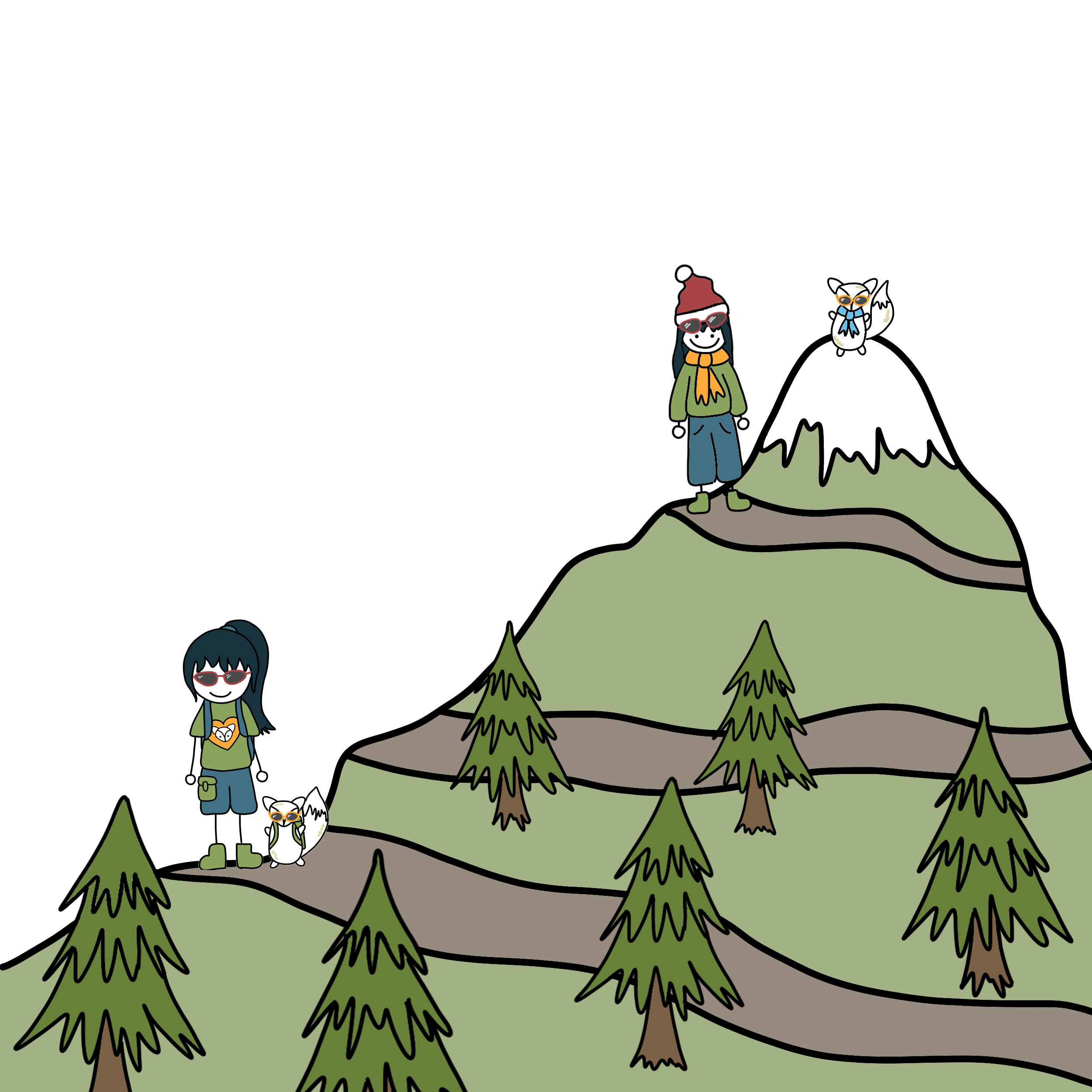
I asked Mika if he knew how it could be that there were no trees growing high in the mountains and that there was even snow on the peaks, while down here in the valley it was not really winter yet. Mika looked at me clueless – then the young woman sitting opposite from us turned around and explained: “The higher in the mountains, the colder the air becomes. Down here, trees still grow, but from a certain height – the so-called tree line – it gets so cold that the trees can’t survive anymore. Above this line only shallower plants, like shrubs and grasses, can grow. Completely at the top nothing grows anymore, so that the stony ground appears and we see the grey rocks.”
Mountain air takes up less heat
“Does that mean“, I asked, “that it is so cold on the mountain tops that it already snows there now in autumn?” “Yes exactly!”, the woman answered, “For every kilometer one ascends on the mountain, the air temperature usually decreases about 6.5 °C. Look at that mountain over there”, the woman said and pointed towards one peak just moving past the window, “– I estimate it to be about 2500 m high. When it is 10 °C in the valley, at the peak the temperature can actually be below zero!”
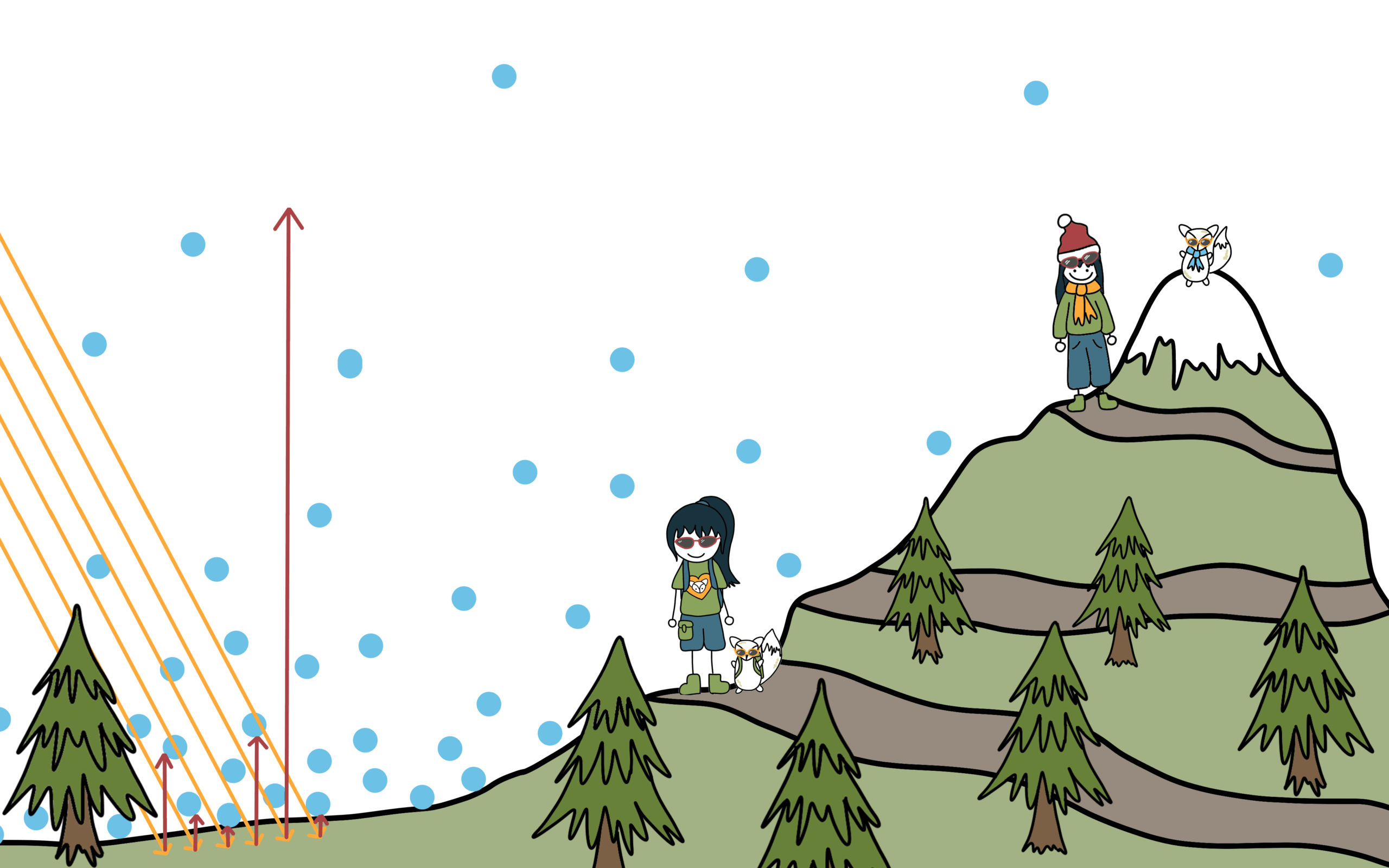
“But why is that?” I asked, “Recently I learned here that mountains receive more sunrays, because there is less air between the sun and the mountain, and that when the sun rays hit the ground, they turn into heat – so shouldn’t it be warmer there on the mountain?” “Good question!”, the woman said, “You are completely right: there are more sunrays reaching the peaks. However, these rays are warming the ground stronger – or our skin as well – than the air. The air can heat from warmth that comes from the ground. The air particles absorb the heat emitted by the ground and then pass the heat back down. But, in the mountains the air is thinner – meaning that there are not so many air particles and therefore less warmth from the surface is absorbed.That is why it is quite cold up there.”
“Why is there more air down here than up there?”, I asked.
In the valley the air is more compressed
“Close to the ground, the air gets compressed by the weight of all the air on top of it. But for air high in the mountains, there is a lot less air on top of it – so it gets less strongly compressed. This is called a lower air pressure. That is a second reason for why it is warmer down here than up there: when air moves down from the mountain into the valley, the air particles kind of get squeezed together from all sides. This makes them move faster, causing the air to warm. The opposite happens when air moves up from the valley towards the mountain peaks: Because the air pressure is lower there, the air can expand – but that costs energy and therefore the air cools.”
That was really a lot of information! Mika still seemed a bit confused. I repeated what the woman explained to us: “The air in the mountains is less compressed because there is not as much other air pressing down on it. Therefore it can expand, which makes it colder. In the valley, on the other hand, the air is compressed by the air above it. This makes the air particles move faster and the air warmer. Because of the higher pressure at lower elevations, there are more air particles in a smaller space, allowing them to better absorb heat from the ground and pass it back down.”
Mika nodded. The woman had to get off the train and said goodbye. “Bye”, she said, “I wish you a very nice vacation!” I looked out of the window again and dreamt of our next mountain hike. I resolved to definitely bring enough warm clothing with me.
Lass dir den Beitrag vorlesen
Text: Swetlana Paul, Illustration: Patrizia Schoch, Translation: Josien Rompelberg