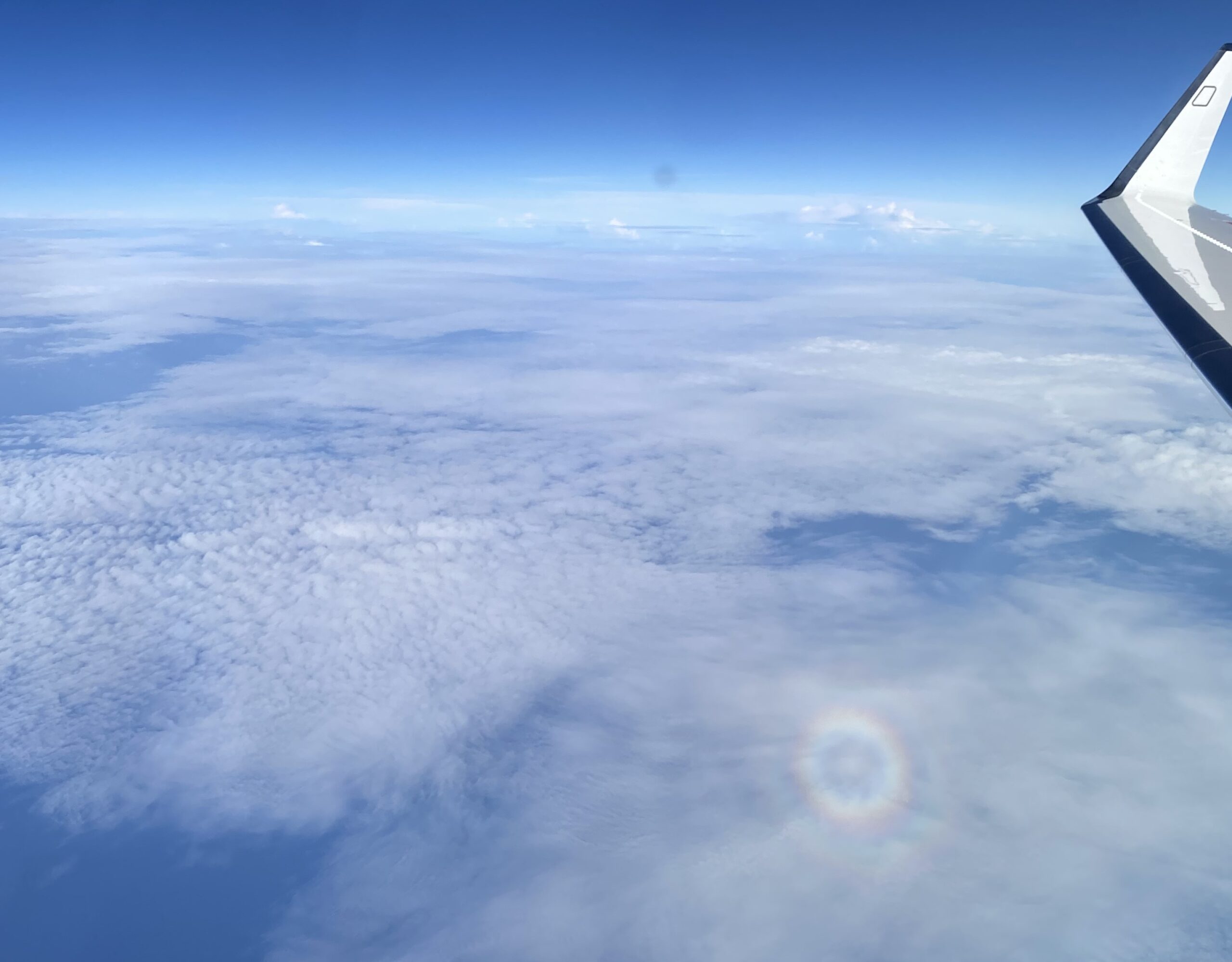



What is a glory and how does it form?
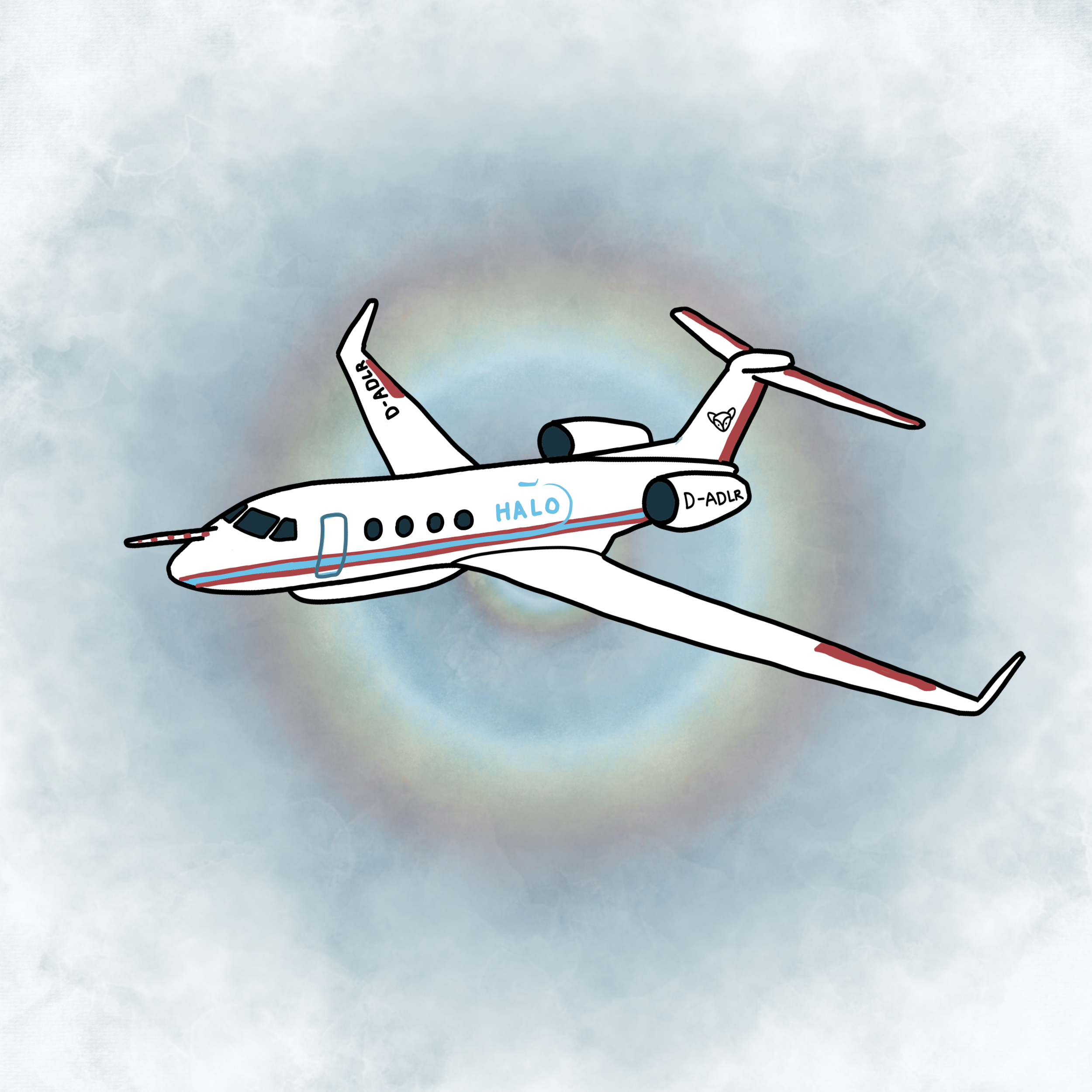
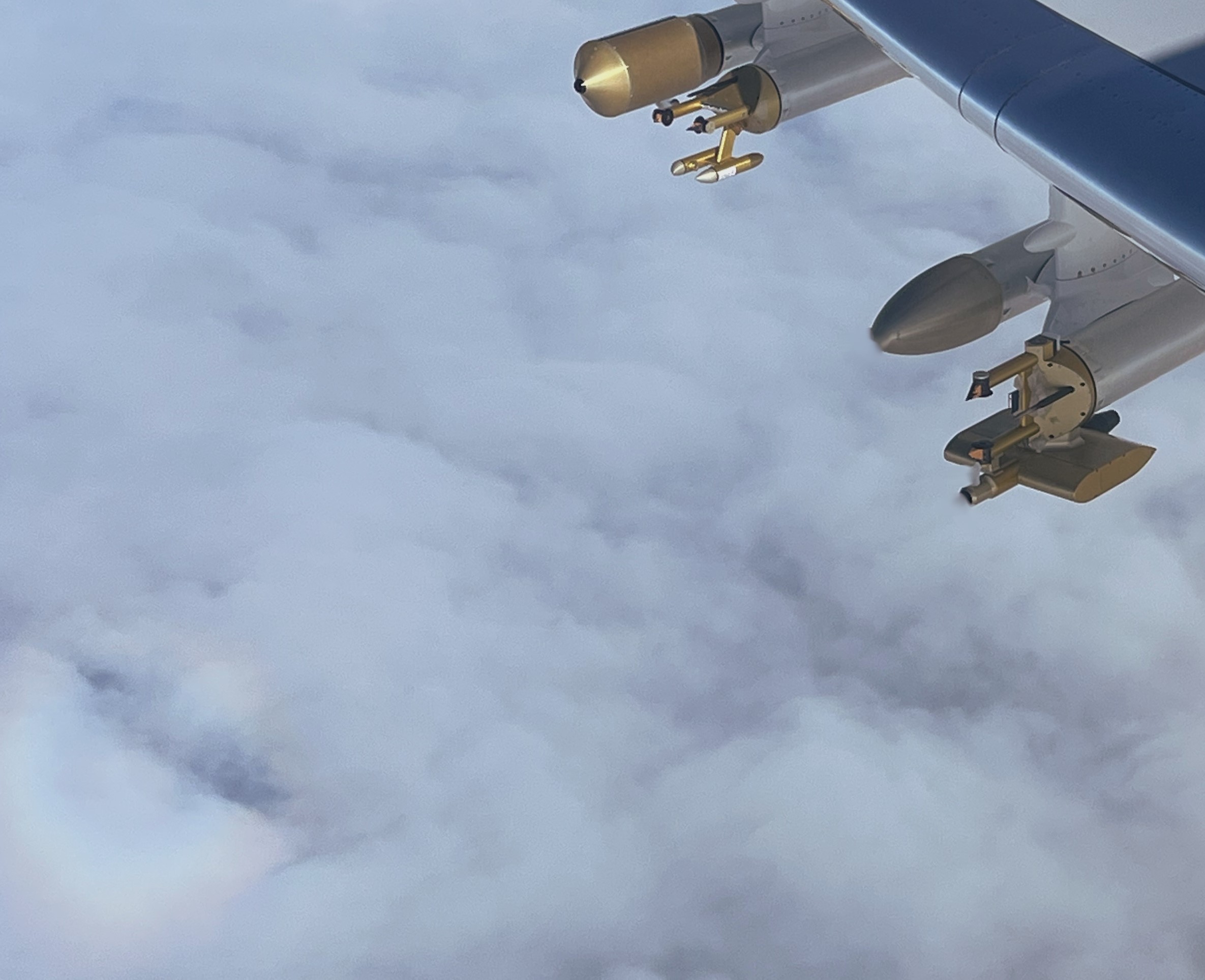
Mia and Mika are sitting together, looking at photos from one of their recent trips. On these trips, they often flew with the HALO aircraft through clouds and studied them more closely. Mia and Mika know that flying isn’t good for the environment. But there are a few other ways to measure clouds.
So when they’re traveling by plane, they like to look out the window and enjoy the passing scenery. There’s a lot to see, especially during takeoff and landing: fields and meadows. Paths and roads connecting villages and towns. But after just a few minutes, the plane is already so high up that all the towns turn into tiny dots. Often, the plane is also flying above a white blanket of clouds.
“That’s always soooo boring,” says Mia.
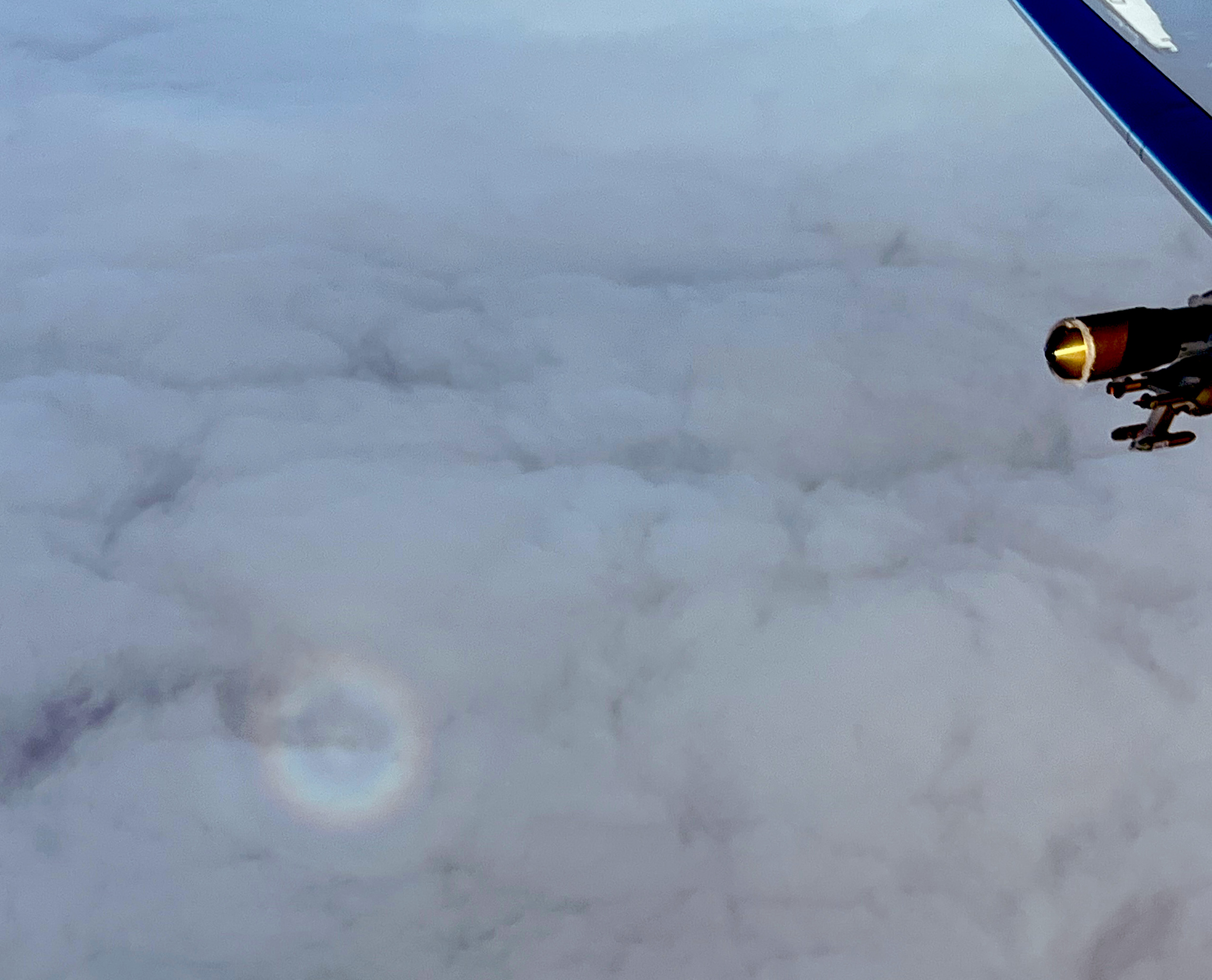
Mika looks at her in surprise and replies immediately: “That’s not true at all! There is still so much to discover up there. Don’t you remember the pictures I showed you the other day? The ones with the colorful circles on the cloud?” Then it comes back to Mia: “Oh yeah, exactly. But how do those rings actually form? You didn’t explain that to me. Is there a name for it?”
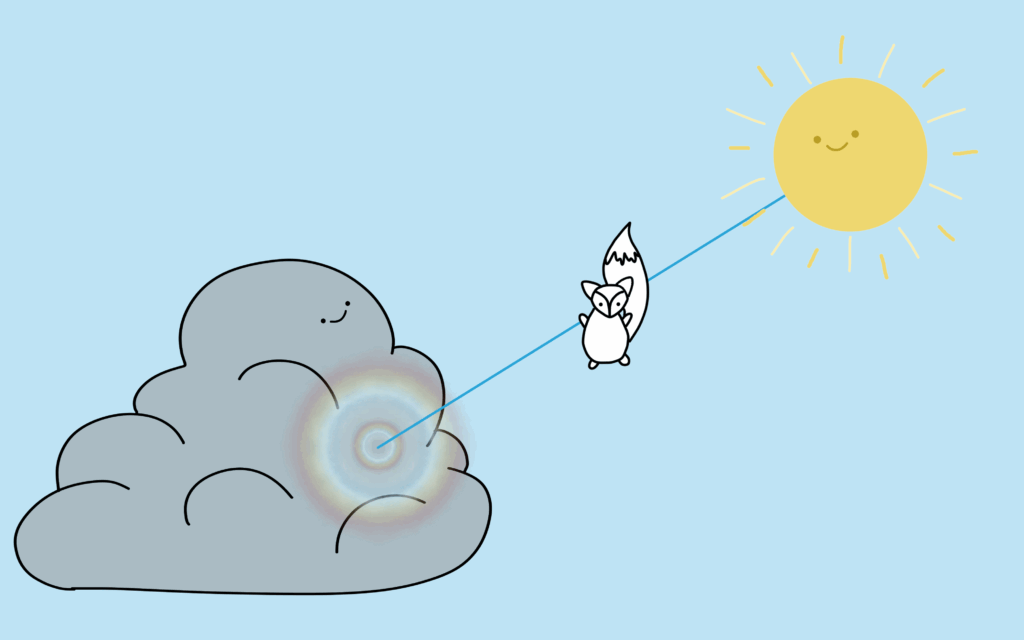
“The phenomenon with the rings is called a glory,” Mika begins to explain. “They are several colored rings that you can see on a cloud under certain conditions. They always appear directly opposite to the sun. Then the sun is behind you and the cloud is in front of you, and you’re right in between.
Inside the rings, you’ll find a bright spot surrounded by a first, darker ring. Around that, you see blue, green, and red rings. Then comes another white ring, and after that, the colors appear in reverse order. Most of the time, you only see one or two of these colorful rings. But if you’re lucky, you might see more.”
Mia is now getting impatient and asks, “But what causes these rings to form?”
Mika begins to explain in detail: “First, you need a cloud with water droplets on the top. It doesn’t work with a cloud made of ice crystals. So we know that the cloud in the photo was made of water droplets. Experts aren’t entirely sure what happens in detail. While you can calculate what happens to the incoming sunbeams, it’s very complicated. I’ll try to explain it very simply. The incoming sunbeams hit the droplet, are deflected multiple times at its edge, and overlap.
But now it gets crazy. A small portion of the sunbeam also travels along the surface of the water droplet. Together, these two effects cause the light beam to be directed almost toward the sun and into your eyes. And this doesn’t just happen with one droplet, but with many of them. They all have to be about the same size, and together they create the circles. The droplets are only a few micrometers in size—much thinner than a strand of your hair.”
Mia says in amazement, “But those are tiny droplets, and somehow it all sounds pretty complicated.”
“Yes, that’s true,” Mika agrees, “And for a long time, people weren’t even sure how a glory forms. But you know what the best part is? Even if we don’t know exactly what’s happening, we can still enjoy it the next time we see a glory.” Mia agrees: “The next time we’re on a plane, we’ll pay close attention and look for a glory. Maybe we’ll see other optical phenomena too. There’s surely much more to discover.”


Text: Kevin Wolf, Illustration: Patrizia Schoch, Translation: Fathima Cherichi Purayil