







What happens to the warm water in the Arctic Ocean?

“Have you ever thought about the Arctic Ocean, Mika?“ I asked. “I read the other day that a lot of warm water from the North Atlantic is flowing into the Arctic. But how warm is the water in the Arctic, anyway, and wouldn’t warm water cause all the sea ice to melt?“

“Yeah, you’re right,” Mika replied. “Why isn’t that the case?”

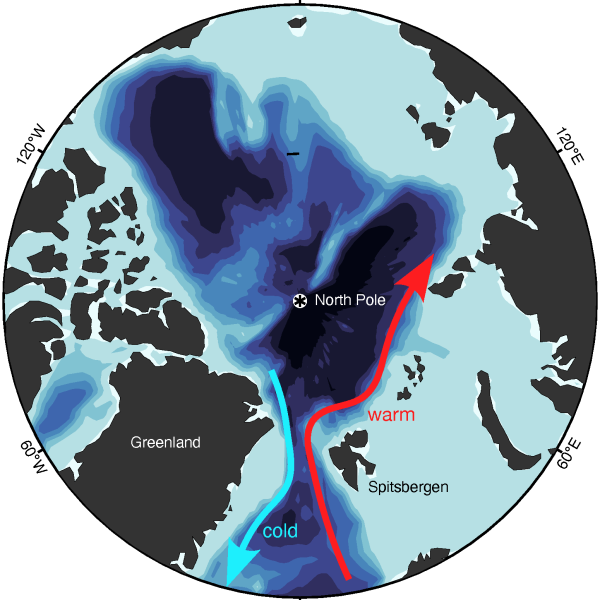
“I asked my friends at the University of Bremen about this, “ I started to explain, “and they explained the whole thing to me. Most of the warm water flows through the Fram Strait into the Arctic Ocean. The Fram Strait lies between Greenland and Spitsbergen. Here, the water is about 4°C. That’s warm enough to prevent sea ice from forming where the water flows, but definitely too cold for people to swim in. From there, the warm water flows counterclockwise through the Arctic and continues to cool down. Cold water leaves the Arctic through the Fram Strait, along the coast of Greenland, and flows toward the Atlantic Ocean.“

“But where does the heat go, and shouldn’t the sea ice be melting?” asked Mika.

“That’s a very good question,“ I continued to explain. “Above this warm water, a layer of very cold, less salty water forms that is lighter than the warm, saltier water from the North Atlantic. This layer is formed by melting sea ice, precipitation, and water from rivers that flow into the Arctic Ocean. This stratification is very stable, and there is little mixing between the warm and cold water because their densities differ greatly. Density describes how heavy water is; the higher the density, the heavier the water. How heavy water is depends on its temperature and salinity. The colder and saltier the water is, the denser—and therefore heavier—it is.

In the Arctic, salt is the main reason why warm water is heavier than cold, less salty water and therefore does not rise to the surface. As a result, the heat does not reach the surface, and in such areas, the warm water is isolated from the ocean surface—and thus also from the sea ice—and contributes very little to the melting of sea ice.

As it flows through the Arctic, the warm water mixes horizontally with colder water and thus continues to cool.”

A bit worried I said: “As the amplified warming of the Arctic and global warming progress, this entire process may change. In the Atlantic, for example, the stratification is not as pronounced as in the Arctic, and there is greater exchange with the ocean surface. Under such conditions in the Arctic Ocean, heat could reach the ocean surface more easily and thus cause the sea ice to melt.“

“That’s interesting—so there’s a huge amount of heat stored in the Arctic Ocean that could melt quite a bit of sea ice!” Mika concluded.

“Exactly,“ I said, „which is why it’s important to understand all the processes involved in mixing and heat transfer so we can be prepared for any changes.“

Lass dir den Beitrag vorlesen

map_mia_en
Map of the Arctic Ocean © Lara Aschenbeck

Text: Lara Aschenbeck, Translation: deepL, Proof-reading: Lara Aschenbeck

Illustration: Patrizia Schoch, Publication and Editorial: Sophie Rosenburg

Communication: Beril Aydin, Accessibility: Sophie Vliegen, Social Media: Komal Navale, Website Maintenance: Patrizia Schoch

5