


The Problem with the Cloud Cover
One fall weekend, I was out and about with Mika. The week before had been rather unpleasant, with rain coming and going. But today, October showed itself from its best side. There was a cloud on the horizon, but otherwise the sun was shining. The weather report had already warned, however, that clouds and showers might still be on the way. And that happened faster than I’d expected. Soon, the cloud on the horizon was getting closer and closer. Fortunately, by the time the first raindrops fell, we had just arrived home. The shower was supposed to pass relatively quickly. When I checked the weather report, I noticed that the current weather was described as “clear.” Strange, I thought to myself. But well, the measurement could already be an hour old. After a few minutes, I checked again. The weather report had been updated in the meantime and now showed “partly cloudy”. I looked out the window and saw nothing but gray. Mika just shrugged, puzzled. That can’t be right.
The next day, I asked Stefan, who works with cloud cover measurements. When the question came up about how cloud cover of the sky can be measured, he couldn’t help but smile a little, since it’s not that simple. We went to a field where many instruments were set up. First, we went to one of the larger devices, which had a warning sign indicating that you shouldn’t look directly into it from above. Stefan said, “This is our ceilometer, which we use to measure cloud cover of the sky.”

“And how does it work?” I asked.
“The device sends a laser beam into the sky. If there’s a cloud, it reflects the beam back, which the device can then detect. That way, we can first determine whether there’s a cloud in the sky at all. From the time it takes for the beam to travel there and back, we can then also calculate the cloud’s altitude,” Stefan explained.
“That’s really exciting!” I said.
“And this method also holds the answer to your question,” Stefan continued, “Since this beam covers only a single point in the sky, a cloud can only be detected when it’s directly above the device. Whether it’s only slightly cloudy or more heavily cloudy can only be estimated. This is done by taking multiple measurements over time and then counting how often a cloud was detected. If a cloud is detected in half of the measurements, then it’s probably partly cloudy. And if no cloud is detected during that entire time, then it’s simply clear.”
Slowly, I began to understand what had happened the day before. The cloud had indeed been very close, but it wasn’t directly above the instrument yet. So the ceilometer couldn’t detect the cloud yet and described the current situation as a clear sky. Even afterwards, the older measurements were still used to calculate the cloud cover, so the device assumed there were only a few clouds overall.
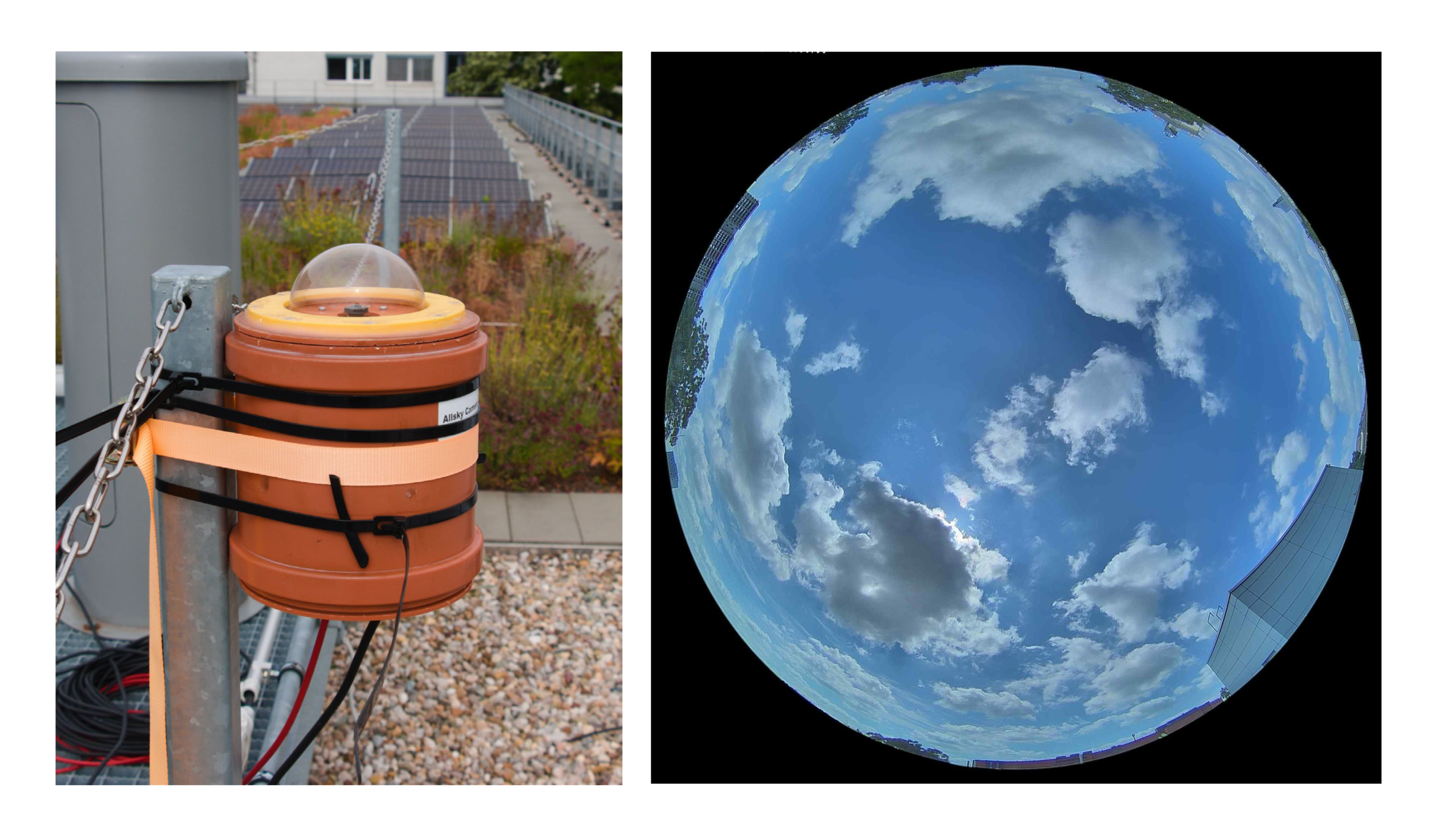
Stefan went on to explain: “That’s how it’s usually measured. However, there are also other instruments we can use to observe the entire sky. For example, this one.” He pointed to a much smaller device a few steps away. “That’s an all-sky camera.” It was just a small box with a little glass dome on top.
“So this device just takes pictures?” I asked.
“Exactly, but it has a special lens built in so the camera can see the entire sky,” Stefan replied. “The clouds are then detected by a computer. It’s simply based on the colors. Clouds are white or gray, while the sky is blue.”
“Or it’s red, like yesterday at sunset,” I added, thinking about how often I’d watched the sunset with Mika.
“That’s exactly the problem with the camera,” Stefan explained, “When the colors change, this method doesn’t work as well anymore. And that’s not the only situation causing problems. For example, the blue sky can only shine through high, thin clouds, which means the cloud can’t be detected. On the other hand, the sun and the area around it are very bright and therefore appear white. So the camera consistently detects a cloud around the sun. And by the way, at night we can’t measure this at all because there’s no light. We don’t have many of these problems with the ceilometer because it emits its own radiation.”
I remembered the conversations I’d had with all the other researchers and thought of satellites. I asked Stefan about this. He replied that the satellites can, of course, see a much larger area, and in the vast majority of cases, cloud cover can be measured very accurately. However, if the cloud is very small, the measurement can become a bit inaccurate even here. This means that, especially with small clouds, the measurement can quickly become inaccurate, particularly if the nearest weather station is a bit farther away.
I thanked him and went back home. I now know that there are certain situations in which measuring the degree of cloud coverage can be inaccurate, even with different measuring instruments. So the day before, we’d just been unlucky.
Text: Stefan Döding, Translation: deepL, Proof-reading: Sophie Rosenburg
Illustration: Patrizia Schoch, Publication and Editorial: Sophie Rosenburg
Communication: Beril Aydin, Accessibility: Sophie Vliegen, Social Media: Komal Navale, Website Maintenance: Patrizia Schoch