



How do seasons occur?

There is a calendar hanging on the wall in my room. It has photos from last year. There is a photo for each month that matches the season. For January, there is a picture of me building a snowman with Mika last year. That was great. As I looked at the pictures, I remembered Mika telling me here that when it’s winter here, it’s summer in the southern hemisphere. That’s strange… Why is that?

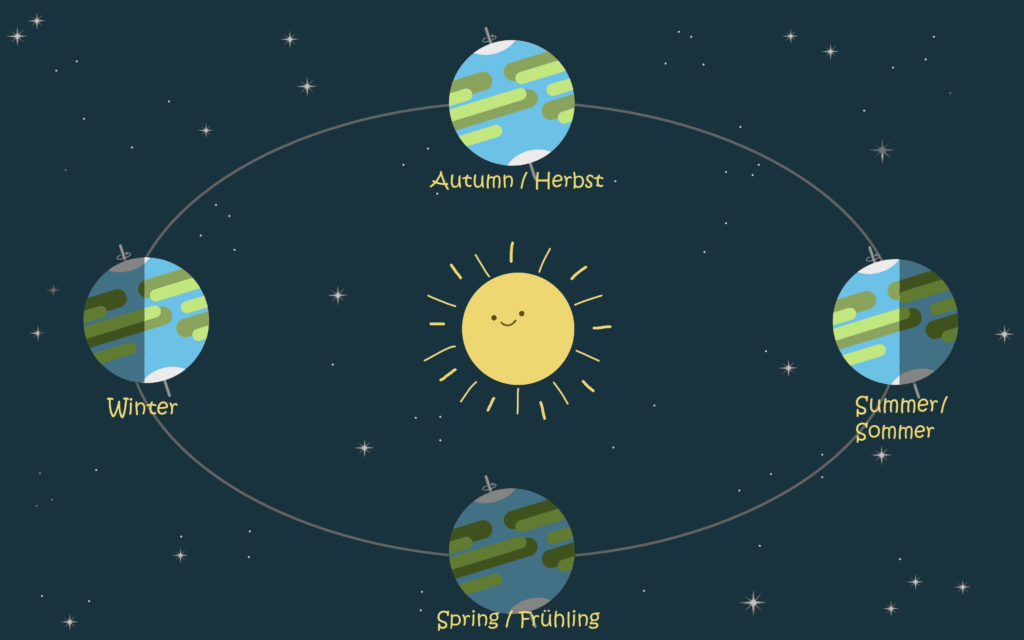
To understand this, I researched how seasons come about. It has something to do with our Earth and how it rotates around its own axis and revolves around the sun. The Earth rotates around its own axis once a day and revolves around the sun once a year.

Let’s start with the former. The Earth rotates around its own axis. However, there are different ways to rotate around your own axis. If you want to rotate, you can either simply turn around while standing, do a cartwheel, or do a somersault. It’s similar with a ball. You can spin a ball around different ‘axes’. And the same applies to the Earth. The Earth rotates around a slightly inclined, i.e. slanted, axis. So the axis of rotation does not simply go from top to bottom, as it would if you were spinning around yourself, but is slightly slanted.

In addition, the Earth revolves around the sun once a year. And because the Earth’s axis is slightly tilted, the northern hemisphere (the upper half of the Earth where we live) faces the sun for a few months (summer) and turns away from the sun for a few months (winter). That’s why the days are ‘longer’ in summer and ‘shorter’ in winter.

In the southern hemisphere (where the kangaroos live), it’s the other way around. When the Earth faces the sun here, it faces away from the sun there – and vice versa. So it’s winter there when it’s summer here, and summer when it’s winter here. It’s crazy. And I learned something else that’s really exciting. In fact, when it’s winter here, the Earth is slightly closer to the sun than when it’s summer here. But that has a much smaller effect than the tilt of the Earth’s axis.

So, to summarize: the seasons occur because the Earth rotates around a tilted axis. That’s why the northern hemisphere gets more sun in summer and it gets warmer. In winter, it’s the other way around.

I never would have thought that the photos in my wall calendar had anything to do with the Earth’s rotation around the sun and the tilt of the Earth’s axis. I learned something new again!

Text & Illustration: Patrizia Schoch, Translation: Fathima Cherichi Purayil

Lass dir den Beitrag vorlesen

12